Not long ago, the future of events appeared to include attendees wearing headsets or using their phones for augmented displays. While planners and suppliers are more reliant on technology than ever, gadgets have been largely displaced by the invisible hand of Artificial Intelligence (AI), guiding the attendee journey.
Planners are adopting AI and other automated tools for their efficiency in predicting and personalizing event experiences, ironic as it may seem. With the right data and programming, planners can successfully suggest education sessions that most closely align with attendees’ objectives and potential business partners to meet on site. The technology can even suggest icebreakers to jumpstart conversations.
Ironically, AI may be the gateway toward making events more human. Its potential and the success of future events depend on planners’ willingness to embrace tools that perform faster than humans. Jim Spellos, president of Meeting U and a frequent speaker on how technology can enhance events, says, “The limitation isn’t what the tech can do; it’s what humans are comfortable doing.”
Where tech steps in
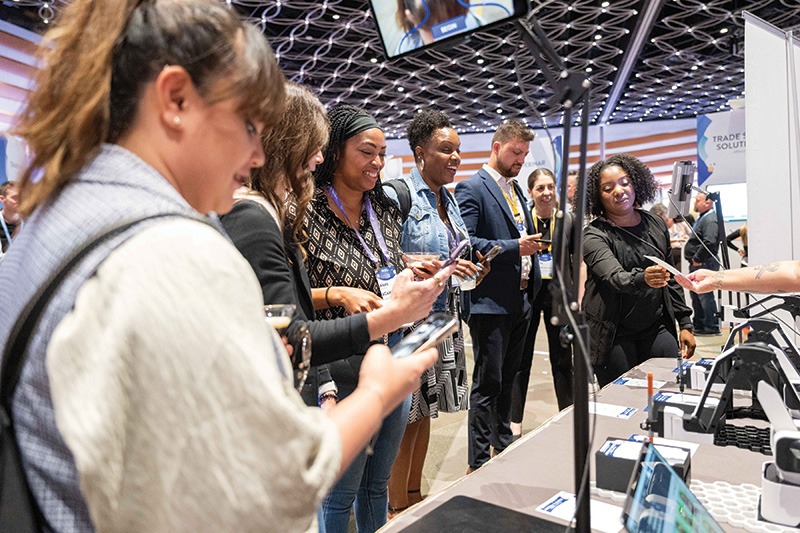
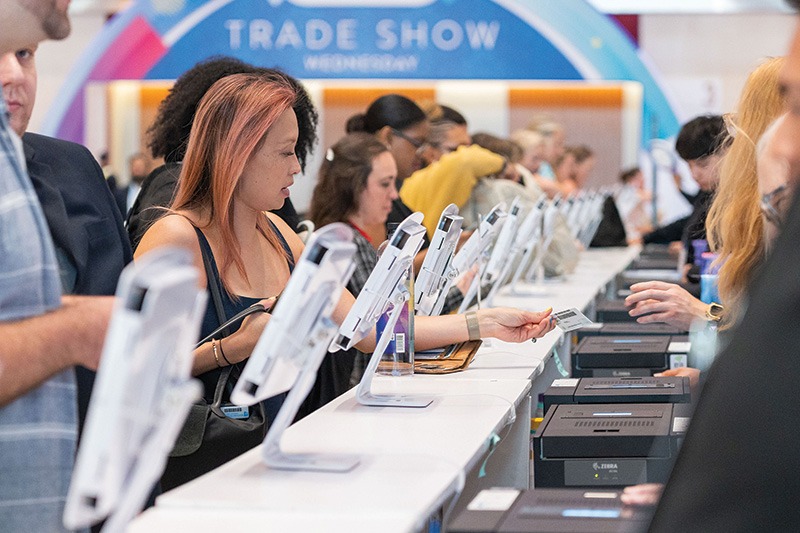
Rachel Andrews, Cvent’s global head of meetings and events, says emerging technology can have the biggest impact on events in three areas: arrival, navigation, and recall. In terms of arrival, a fast, tech-enabled check-in and badging experience sets the tone immediately. “No one wants to start a conference by standing in line,” Andrews says. A strong event app and clear digital signage help attendees navigate sessions, activations, and networking without anxiety, she adds. Lastly, tools that help attendees retain and use what they learned provide long-term value.
“For me, a great attendee experience is when people feel seen, supported, and energized from the moment they consider attending to long after they fly home,” says Andrews, whose portfolio of events includes Cvent Connect, the flagship conference for the industry’s leading technology provider. The annual summertime show drew approximately 4,000 event professionals, marketers, and hoteliers in 2024 and 2025, and is expected to see increased participation for the 2026 conference in July.
Whether planning large shows like Cvent Connect or intimate boardroom meetings, organizers share the same goal of making the event as easy to navigate and as enjoyable as possible. With increased workloads and huge pressure from boards of directors and C-Suite executives, event professionals must find simpler ways to do their jobs. That’s where
AI and other automated tasks come in.
Veteran planners might recall the days of manually entering data into Excel worksheets to track registrations and shipments. Today, many workflow programs used across the industry include built-in AI programs, which perform mundane tasks in a fraction of the time humans can. As a result, planning teams gain time back, allowing them to focus on other details and touches designed to improve the event and attendee experience, and to interact with guests more, providing valuable one-on-one customer service.
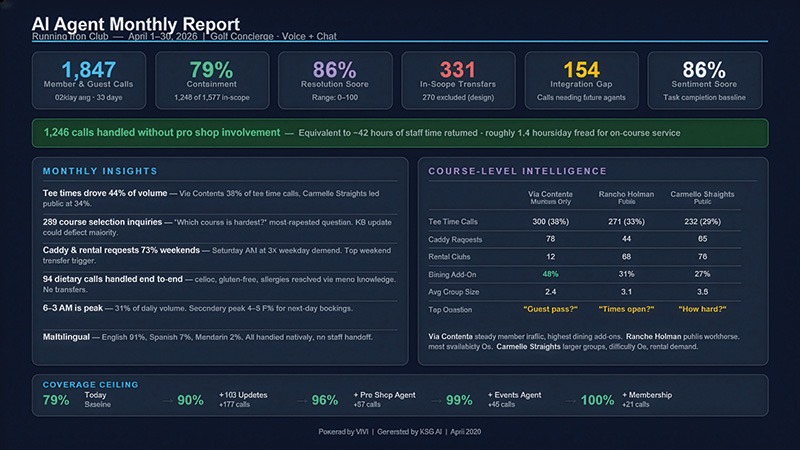
“It’s about allowing people to get back to delivering the hospitality experience to the humans in front of them,” says Lance Thompson, president of VIVI, a voice and chat AI platform built for luxury hotels and resorts. VIVI clients include Ocean Properties, a Florida-based chain.
VIVI assists with the planning process before an event. It handles 24/7 multilingual reservations, dining and spa bookings, F&B orders, and concierge requests. The general idea is to be more efficient than the traditional phone menu system. “We’re trying to eliminate the ‘press one, press two’ experience entirely,” Thompson says.
By drawing on hotel data, VIVI also aims to provide consistent customer service and information based on AI’s deep knowledge of the property—reducing the need for guests to inquire directly with hotel staff. Hotel sales staff can use the technology to draft RFPs and analyze operations, freeing them to reach out to prospective clients personally.
These types of real-world examples illustrate AI’s ability to go beyond incremental improvements for planners, attendees, and suppliers, according to Spellos. “AI is not just a tool but a fundamental shift in how event work gets done,” he says. “This is transformational.”
Rumors that technology soon will run shows are greatly exaggerated, Spellos says. “You need a human being to run a conference. We’re not at the point where robots are going to do that.”
Maintaining the human touch
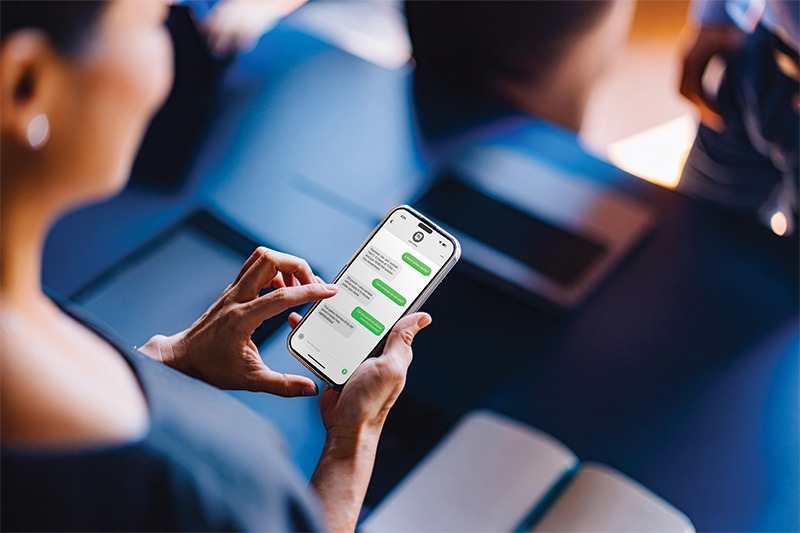
Jordan Kaye, CEO of Analog Events, with 20 years of experience producing live events, grew so tired of dysfunctional, fragmented tech stacks that he launched his own SMS concierge. The new technology is designed to smooth the experience for everyone involved in an event.
Agent Analog is Kaye’s AI-powered attempt to take the event app out of the process. Attendees text one number for real-time support throughout the event, whether they need help with schedules, directions, F&B orders, or networking. It is part of a larger shift in which brands, companies, and governments anticipate users asking questions in real time rather than simply relying on prompts to complete tasks.
“It’s like placing a Starbucks order, but for your event,” Kaye says. His current event clients, including tech and pharma companies, have already adopted the text-based option. He aims to expand Agent Analog’s client base later this year.
To use the concierge tech service, planners upload their event agenda and other logistical information, and the AI can parse information into a brief summary for attendees. “No one wants to read six pages of FAQs,” Kaye says. “You just want quick, immediate answers.”
A centralized dashboard, which is platform-agnostic because it runs via Google Sheets, tracks attendee interactions, preferences, and responses, and provides real-time analysis. Kaye says benefits for planners like himself include reducing the burden on staff to answer repetitive questions, improving responsiveness, and troubleshooting in real time.
As Spellos noted, Kaye agrees that humans are essential for the concierge to be an effective tool. He believes attendees will find the text format refreshing. “It feels human, but it’s powered by tech,” he says.
Personalization matters
Today’s event attendees crave person-to-person interaction, like building vendor relationships, learning and development, and making connections, according to Freeman’s 2025 Experience Trends Report. Technology can assist with those types of connections, Andrews says. Cvent uses data and AI to identify attendee preferences, including roles, past behaviors, and session interests, and then offers smart recommendations, such as session suggestions and networking matches. Attendees have the choice to accept or ignore the recommendations.
“The result is personalization that feels thoughtful and human, with AI quietly doing the heavy lifting in the background,” Andrews says.
Personalization can be powerful for planners seeking to tailor events to specific audiences.
At Cvent Connect, Andrews and her team used data and AI recommendations to craft a curated executive experience for senior leaders. By combining registration data, product usage, roles, and interests, they curated learning paths and intimate peer discussions, then used the Cvent app to surface the most relevant sessions, roundtables, and networking opportunities.
“Executives told us they felt like every block of their agenda had purpose—less wandering, more intentional conversations—which is exactly the outcome we want from intelligent event design,” Andrews says.
Event organizers also crave actionable analysis to improve future shows. That data already exists, but often goes underutilized, says Jacob Kinnander, CCO of Voxo, which uses AI to create real-time session summaries within minutes of conclusion. The issue is how we consume information, he adds. “People only retain approximately 10% of information after seven days.”
Data is also being used to enhance wellness-based activities at hotels like Carillon Wellness Resort in Miami. Carillon uses cutting-edge technology with a range of health benefits, such as rapid recovery, weight loss, relaxation, and rejuvenation.
Learning experiences
According to the latest Freeman trends report, Unpacking XLNC: The Future of Adult Learning at Conferences and Trade Shows, 70% of attendees rank in-person events as their top source of professional learning, yet participants sense the experience is not reaching its full potential.
Voxo aims to fill the gap. “What we saw at events was how much effort goes into them and how much content gets lost,” says Kinnander.
The Voxo technology, which was employed by Informa Connect at the 2025 AI Summit, aims to take the pressure off attendees who are rushing to take pictures of slides, take notes in real time, or have to choose attending one session over another scheduled at the same time. Content is delivered in multiple formats, including text, audio, visual, and social-ready blurbs to best match the audience. The results can be branded to match the event’s visual identity and are available on event apps, content hubs, and mobile interfaces. Attendees can access it during the event or afterward. “Without AI, it takes weeks or months to create this content,” Kinnander says, noting the myriad formats present sponsorship opportunities.
Cvent offers a similar product, Session Snapshots, an AI-powered feature in its Attendee Hub app. Across more than 30 sessions, attendees could tap a single button to capture the “moment that mattered.” Behind the scenes, CventIQ generates a real-time transcript snippet, a slide image, and an AI summary of that exact moment. “People feel more present in the room because they can trust the tech to capture all the details for them,” Andrews reports.
Data analytics track engagement metrics like downloads, views, and interactions, so organizers can identify which sessions drive the most interest. While making improvements for future shows is valuable, Andrews thinks planners should have confidence on the fly if the data calls for a quick change.
“The goal is to treat the event as a ‘living system’ that responds to attendee behavior, not a static schedule,” Andrews says. “If we see that certain cohorts (for example, first-time attendees or a particular segment) aren’t using the app or aren’t participating in networking, we’ll adjust our in-room scripts, send tailored nudges, or deploy staff to personally invite them into experiences.”
Given how quickly technology, especially AI, adapts, it’s important to regularly evaluate how tools are working for your event. Andrews’ top three metrics to monitor are session attendance rate vs. forecast, net promoter score, and post-event attendee action rate (did the attendee do something after the event that demonstrates value was delivered?).
Where is tech headed?
Even with AI, predicting the future is challenging. Information and technology help us to make educated guesses.
According to Spellos, the biggest opportunity for organizations is in building custom AI tools tailored to their specific event needs. Claude, an AI assistant designed by Anthropic, is a popular tool for hands-on event professionals to create solutions that can be incorporated into their current event stack, he adds.
“The future of event tech is not just adoption, but ownership and customization,” Spellos says, noting simple automations like file organization and news aggregation demonstrate AI’s everyday value. “If you have a pain point, you can fix it.”
Among the challenges is cost savings. Technology can streamline operations and eliminate unnecessary expenditures. Wordly, an AI-powered translation service, estimates event organizers have saved more than $100 million since 2019 by using AI translation because they don’t need to pay human translators in order to expand their events’ reach to international audiences.
Andrews sees three shifts that will reshape the attendee experience in the next few years: AI copilots for attendees will move from simple recommendations to true assistants that help people plan their time; smarter, more connected onsite environments—from computer-vision-informed traffic insights to adaptive room setups—will make events feel more fluid and less constrained by fixed schedules and floor plans; and more AI-powered tools will be used to repurpose live sessions into tailored follow-up content, micro-learning, and ongoing communities, turning the event into a launchpad for something more, rather than a one-off moment.
According to Andrews, many of these improvements should feel seamless as AI is increasingly integrated into our daily lives. “The best tech has become more invisible,” she says. “When we do our jobs well, AI, automation, and data sit in the background, quietly removing friction so that what attendees remember is not the tool, but the conversation—the ‘aha moment,’ or the relationship that moved their work forward.”