Each year, countless individuals embark upon journeys across the globe to participate in volunteer opportunities, eager to give back to communities in need. These altruistic travelers invest their time and resources to make a positive impact. This same spirit of giving back applies to meetings and events as well. Many planners are exploring opportunities for attendees to give back to the communities where they hold meetings and conferences.
The trend of voluntourism—the practice of integrating volunteer activities into travel experiences—is more popular than ever. For business, including meetings and events, this concept is known as corporate social responsibility (CSR). Businesses and organizations look for opportunities, locally and when traveling, to contribute to the community rather than just be consumers of the community. “It was more of a teambuilding component initially. I think people’s hearts have changed in recent years and they are intentionally trying to add in ways to give back,” says Crystal Hendrickson, vice president of sales and public relations for Pinnacle Partnership in Spartanburg, S.C. “Most people want work to mean more than just work.”
Hendrickson adds, “I think people now are looking for different ways to connect and to make a difference. We are all particular with how we spend emotional and literal currency. So, voluntourism projects are a great way for planners and destinations to add a meaningful component to a meeting or conference.”
Melissa Riley, senior vice president of convention sales and services for Destination DC, underscores the growing demand for purposeful meetings. “People want to meet with purpose now,” she says. “The reason why people attend conferences has changed. They really prioritize things differently; in addition to education and networking possibilities, they want to have something purposeful when they meet in a destination.”
Destination DC has embraced this trend through its Connected Community initiative, which aims to create positive legacies in Washington, D.C. “We believe destination marketing organizations (DMOs) now have a far greater responsibility to the residents of the cities they represent,” Riley explains. “It is not just people coming to town for three days, have their conference, and then go home. There is a far greater opportunity these days to have a positive societal impact as well, and we seek to engage our customers in this way to create a positive legacy in D.C.”
As part of the initiative, Destination DC works with several organizations within the district to accomplish its goals, such as Serve DC, which has the pulse of the needs within the community. “We try not to do things that are necessarily ‘canned’ activities, where we just have a list of things for groups to pick from,” Riley says. “We want something of great value to both the organization and the city in which they serve. So, we want to partner with those who understand what the needs are and where there is a deficit.”
One notable example is the collaboration with Greenbuild International Conference and Expo, which led to the creation of the Greenbuild Legacy Project Roots to Success initiative at Kelly Miller Middle School in Ward 7, a food desert where healthy food options are severely limited or simply not affordable. The group had specific objectives: to refresh the school’s cafeteria with new composting facilities, integrate food sustainability education, and create an urban garden to provide students with access to healthy food and teach them how to eat healthy. “All of that happened out of one group coming in and creating the opportunity,” Riley adds. “It was not just a one-time CSR project. It will have a lasting impact.”
The Greenbuild Legacy Project Roots to Success program at Kelly Miller Middle School will have lasting impact not only for current students but also future students, notes Sade Dennis, director of market transformation and development for Maryland, national capital region and Virginia, for the U.S. Green Building Council. “The collaboration and dedication of the volunteers, partners, and stakeholders in the Greenbuild Legacy Project Roots to Success truly made a difference not only in renovating the school facilities but also in showing the students at Kelly Miller Middle School they are supported and valued by their community,” Dennis says. “This project exemplified the power of collective effort in fostering a sense of care, health, and success for the future generations.”
To facilitate more of these types of initiatives, Destination DC has appointed a senior manager of sustainability, who leads discovery conversations with customers to identify meaningful volunteer opportunities. “We are proud of the fact we were one of the first urban destinations in the country to do this,” Riley says. “We realize when it comes to sustainability there is a lot of work to be done. We see legacy and impact as a part of the framework of sustainability.”
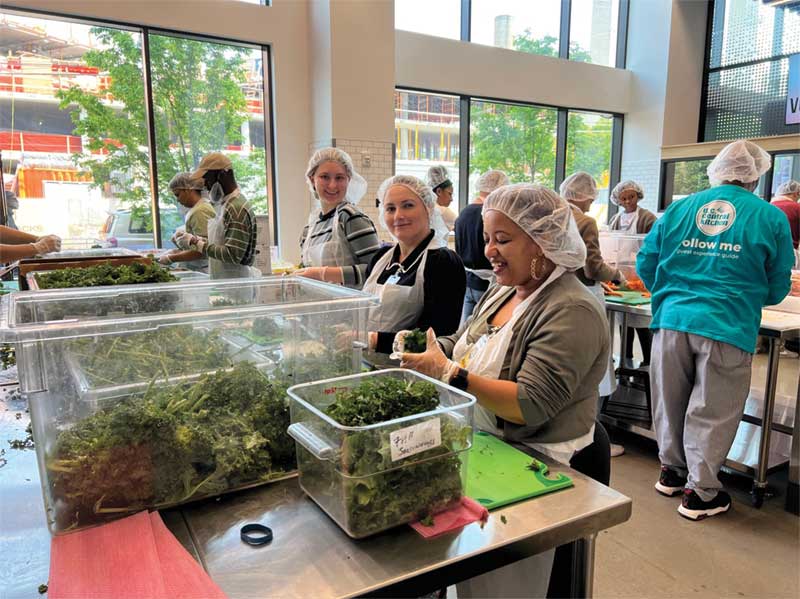
Destination DC collaborates with local partners toward shared sustainability and community-impact initiatives. This includes working with top meeting markets, such as medical associations, in identifying opportunities to help local residents. Healthcare clinics are a great way for visiting medical associations to serve the community, Riley says. “We get this type of interest from many medical groups. It is amazing to see residents take advantage of these healthcare services they otherwise could not afford.” As Riley explains, groups can take part in many different levels and types of service activity, from conducting free clinics at the convention center to hosting fundraisers. “Regardless of what they choose to do, we want groups to embrace leaving something behind for D.C. residents.”
Trish Fancher, executive director of Keep Lee County (Fla.) Beautiful, helps organize environmental projects for conferences and conventions hosted in the area. The organization arranges unique opportunities for attendees to engage with the local community through community clean-ups, waste reduction, environmental education, and community greening. “When you go out and do projects like these, you really get to meet locals, find out why they love it here so much, learn about the secret spots, appreciate why people love it here so much, and see different parts of the county than you would probably ever travel to if you’re only doing standard tourist things,” she explains. “It is a great opportunity to learn about the place you’re visiting and see it in a whole different way.”
One of the most popular activities organized by Keep Lee County Beautiful is tree planting, which offers a lasting impact on the environment and is much needed currently, as the area is still recovering from Hurricane Ian. “We had a group come down from New York and put in 1,800 sea oats on a beach to try to help prevent some flooding in the future, as sea oats help build dunes,” Rancher says. “We are still doing clean-ups and other activities, and we always will, but the plantings are the most popular. Groups like to be able to come back in two, five, or 10 years and say, ‘I did that.’”
Lee County Visitor and Convention Bureau (VCB) works with groups coming to the area as well, helping organize everything from beach clean-ups to assembling and distributing food kits with local food banks. Lee County VCB partners with a number of organizations within the local community to create voluntourism opportunities for visitors, such as Echo Global Farm, which provides opportunities to help create community gardens, and Sanibel-Captiva Conservation Foundation’s Coastal Watch Program, which includes mangrove restoration, replanting, and oyster-bed restoration. “Most groups want to do beach clean-ups,” says Nancy MacPhee, manager of product development for Lee County VCB. “We had a group last fall that wanted to do a beach clean-up, but the group’s hotel was about 40 minutes from the beach, and they only had a two-hour window. We ended up doing something on property at the hotel: replanting vegetation that was lost during the hurricane.”
In Sanibel and Captiva, kayaking the local paddling trail is a popular activity—and an easy match for volunteer opportunities. “For groups staying in a hotel on the water, they can launch kayaks from there and pick up trash tucked in mangroves, while also seeing dolphin, manatee, and various bird life,” MacPhee says. “We see groups request that because it is fun, and they can also help clean up.”
MacPhee hopes to launch a more robust voluntourism program later this year in an effort to get more activities on more meeting and conference agendas, but she acknowledges it is important the activity align with what the company itself would prioritize. “Groups have to reflect on their own company values,” she explains. “They should choose something that aligns with their mission. Perhaps they should even survey their attendees to find out what they might like to participate in.”
Fancher echoes the need for the planner to align the volunteer activity with the mission of the company, as well as the interests and passion of the attendees themselves, to ensure a successful and enjoyable experience. “Try to find out the overall desires of the group,” she says. “For example, if you have a group of 40 coming down for a conference and they all hate being outdoors and you’re going to force an outdoor activity, it will not go over well.” Fancher suggests planners first ask the group what would interest them, then offer them a few options.
In addition, Fancher stresses the importance of setting up the group to have fun—not to just work—and making sure the activity is well organized, so they do not feel as if they are wasting their time. “We recently had a group to plant trees on a Saturday morning, and we made sure it was a fun day, with music, food, and everything needed all ready to go,” she says. “There was no lag time and no standing around. Now, some of those attendees, who live locally, are planning projects for this fall because they had such a good time.”
Fancher also notes it is important for voluntourism activities to wrap up within a few hours. “People frequently say they want to work five or six hours, but we keep our events shorter,” she says. “We have learned three hours is usually the cap, because we are doing hard work. We want to give them a taste, a sample, of the community and the opportunities here.”
Purpose-driven itinerary
Hendrickson emphasizes the importance of making volunteerism a core component of event programs, rather than an optional activity; otherwise, after a long day of meetings, attendees could be too tired and become disengaged—or too tired to participate at all. “I encourage people to incorporate volunteer events in the meat of their programs, in the meat of their days,” she says. “People are tired and have to choose how they spend their energy, so I would love for volunteerism and advocacy to be a main component of the day.”
Incorporating the volunteer event into the day’s agenda also underscores its importance, Hendrickson adds. “If the organization is trying to maximize time and also show giving back is an important part of the program,
you should plan for a morning, breakout, or lunch session—activities like stuffing book bags, putting together bikes, or visiting a local organization—rather than after the day’s events are over,” she explains. “If they are after-hours people and they feel it would be impactful and fun at the same time, by all means do what works best. It goes back to knowing your audience.”
Maximize service impact
Even when planners develop the ideal volunteer activity, they can face challenges in making it happen. In some cases, nonprofits are not equipped to handle large groups of volunteers. “Oftentimes, nonprofits are small, and a few people are doing the jobs of many,” Hendrickson says. “They might not have tools and resources to be as organized, or ready to suggest projects or have projects ready, or have volunteer slots available.”
Hendrickson suggests this is where CVBs and DMOs come into play. “The best way we can help nonprofits is to come with suggestions,” she says, noting the more lead time the better. “Even if there are ready hands or open wallets, the nonprofits need time to prepare,” Hendrickson says. “If possible, do a site visit ahead of time with the organization you are looking to partner with and brainstorm ideas early on as to what the activity could look like. This will help ensure the nonprofit will be ready for the influx of people.”
Despite these challenges, Hendrickson remains optimistic. “People come away feeling more connected and enriched when they have the opportunity to volunteer,” she says. “As humans, we naturally do things that make us feel good because it is how we are wired. Volunteering makes you feel good because you’re giving back, and you’re doing it side by side with co-workers. You are doing a good thing together. I would even argue the volunteer component can be the most important part of your event agenda. Attendees will always remember the volunteer activity they did. Our job as planners and hosts is to entertain people, educate them, and ensure they have the best time possible for their money while they are under our care. If this enriches them personally and other people benefit from it, too, then even better.”