WASHINGTON, D.C.—The nation’s capital welcomed more than 27.2 million visitors in 2025, marking its third consecutive year of record visitation and economic impact, according to Destination DC.
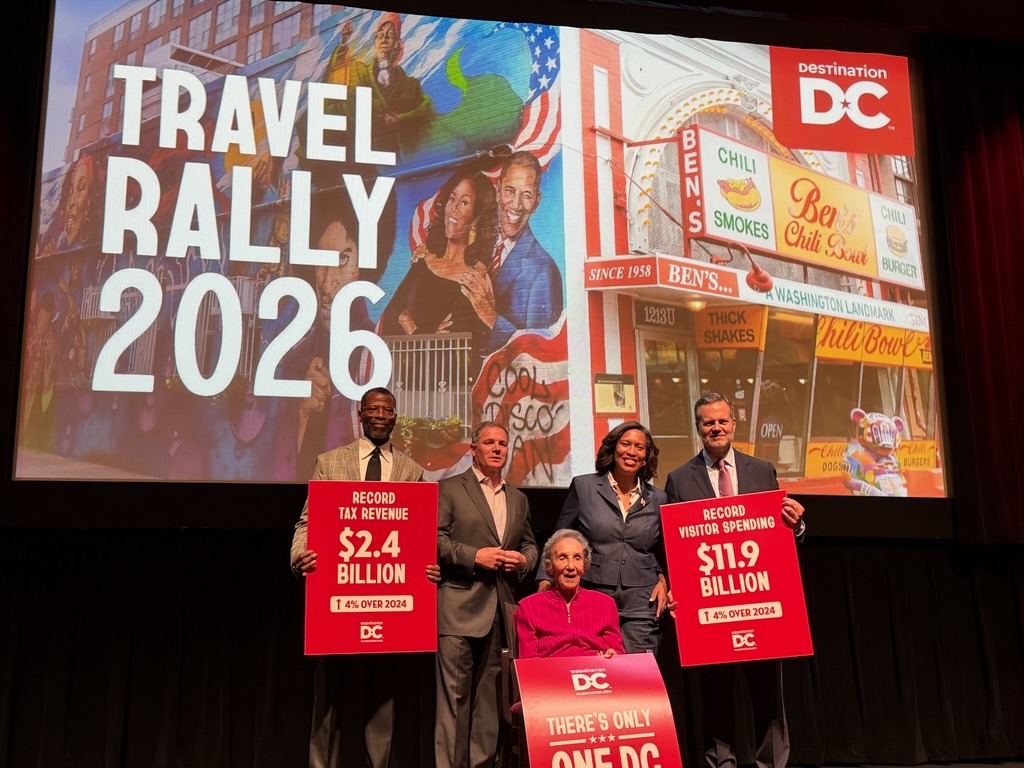
The city’s official destination marketing organization reported that visitation edged up by 20,000 travelers over 2024 levels, while visitor spending reached a record $11.9 billion. Tourism also generated $2.4 billion in tax revenue and supported 114,013 jobs across the city.
Domestic travel increased slightly year over year, with 25.1 million U.S. visitors traveling to the capital in 2025. International visitation declined 4% to 2.1 million travelers, though the decrease outperformed the overall 5.5% decline in international visitation to the United States.
“The fact that Washington, D.C., saw record economic impact for the third straight year, especially in a challenging global environment, speaks to both the enduring appeal of our destination and efficacy of our sales and marketing,” says Elliott L. Ferguson II, president and CEO of Destination DC (DDC). “As we celebrate that, however, we remain steadfast in our efforts to entice international visitors [who] stay longer and spend more.”
According to DDC, tourism marketing efforts contributed significantly to the city’s economic returns. From April 2023 through October 2025, the organization received additional hotel tax funding through the tourism recovery district. A study conducted with the D.C. Office of the CFO and Future Partners found that DDC’s $19.5 million advertising campaign in spring and summer 2025 generated $41.3 million in tax revenue and $470 million in visitor spending.
“Overall, the record economic contribution from visitation creates immediate impact. That’s why now is the time to reinvest in marketing, because when DDC has additional dollars to spend and a steady source of funding, the city sees bigger returns,” Ferguson says.
The city’s fiscal year 2026 budget reallocated tourism recovery district funding, resulting in a two-thirds reduction to DDC’s overall advertising budget, though the D.C. Council approved a $6 million earmark for marketing and sales initiatives.
Mayor Muriel Bowser pointed to major events and attractions driving continued tourism momentum. “We live in the best and most beautiful city in the world, with fantastic restaurants and hotels, great parks, and a public transit system that takes you all over the city and region. And we love to show off our city to visitors from across the country and around the world,” Bowser says. “We had some great events last year, like World Pride and the FIFA Club World Cup, and this summer we have a full lineup of America 250 events. So, we want people to check out all we have to offer, book their trips, and come visit us in Washington, D.C.”
DDC unveiled the latest tourism figures during its annual Travel Rally at the Lincoln Theatre in partnership with the U.S. Travel Association. “Travel is essential to the U.S. economy—but too often it’s treated as optional in policy decisions. That has to change,” says Geoff Freeman, president and CEO of the U.S. Travel Association. “Prioritizing travel means strengthening our economy, supporting millions of jobs, and ensuring the United States stays competitive on the global stage. That’s where we need to stay focused in the months to come.”
Looking ahead, DDC officials expect the nation’s 250th birthday celebrations in 2026 to drive additional visitation. The city plans a yearlong lineup of events, exhibitions, and festivals tied to the commemoration, including opening the National Geographic Museum of Exploration, an innovative museum underneath the Lincoln Memorial, expansion of the National Air and Space Museum on its 50th anniversary, and an improved Tidal Basin with new exhibits at the Jefferson Memorial and the African American Civil War Memorial Museum.
The destination also continues to position itself as a leading meetings and conventions market. In 2026, Washington is scheduled to host 18 citywide conventions, representing approximately 376,000 room nights, 246,000 attendees, and an estimated $317 million in economic impact.
“The continued growth in tourism’s economic impact in Washington, D.C., speaks to the strength of the destination and its global appeal. International visitors tend to stay longer, spend more, and build deeper connections to the United States,” says Fred Dixon, president and CEO of Brand USA. “As we look ahead to major moments like America’s 250th [birthday], destinations like DC will play an important role in inspiring global travelers to visit.”